
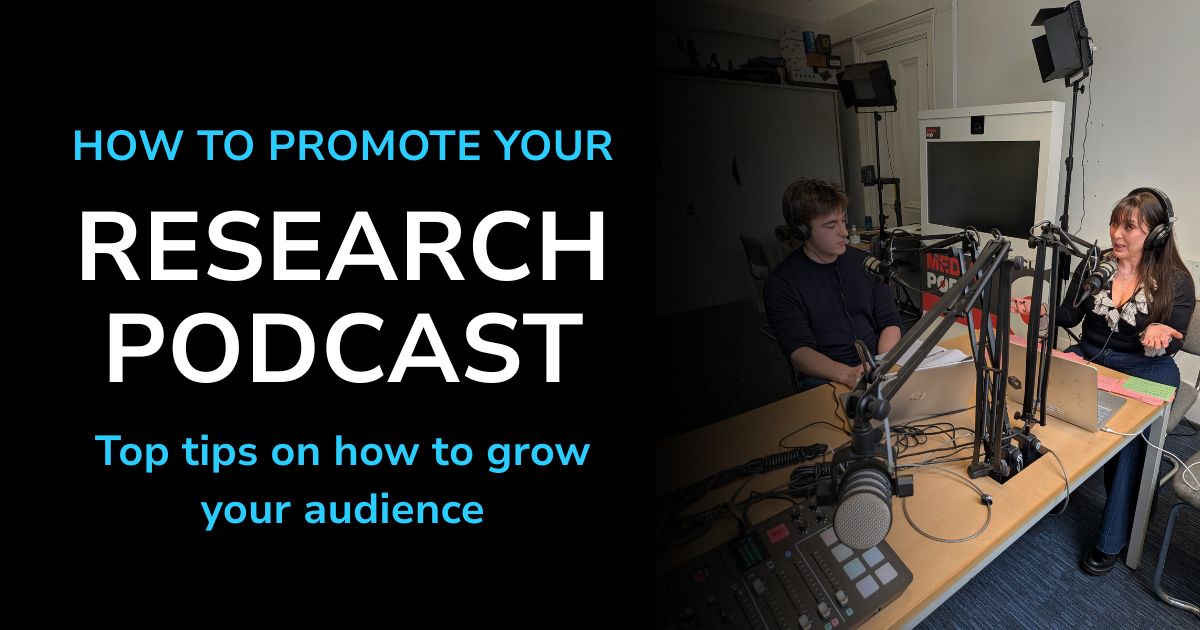
How to promote your Research Podcast: Top tips on how to grow your audience
You’ve spent weeks (or even months) planning, recording and producing your podcast. Now it’s live, but how do you make sure people actually listen? How do you promote your podcast?
The good news is that promoting your podcast doesn’t have to be complicated. Small, consistent actions can significantly increase your reach and help your research find new audiences.
Here are some of our favourite ways to promote your podcast with minimal extra effort.
1. Add your podcast to your email signature
One of the easiest ways to promote your podcast is to include a link in your email signature. Every email you send becomes an opportunity to share your work with colleagues, collaborators, students and external partners.
Include a simple, direct call to action such as:
- “Listen to our latest podcast exploring…”
- “Discover our research podcast here.”
If you regularly communicate with large groups, this small change can generate a surprising number of listeners over time.
2. Include your podcast in presentations
Whether you’re delivering a lecture, presenting at a conference or speaking at a public engagement event, don’t let your podcast be an afterthought.
Add a final slide featuring:
- Your podcast artwork
- A QR code linking directly to the episode
- A short description of what listeners can expect
Many people are interested in learning more after a presentation, and your podcast provides an easy way for them to continue engaging with your research.
3. Feature new episodes in newsletters
If your department, research centre or university distributes newsletters, make the most of them.
Include a short summary of your latest episode, a compelling quote from your guest, and a direct link to listen. Newsletters already reach audiences who are interested in your work, making them an ideal place to showcase your podcast.
4. Make the most of social media
Social media remains one of the most effective ways to build an audience, but don’t stop at simply announcing a new episode. Instead, create several posts from each episode over a few weeks.
You can share:
- Key quotes from your guests
- Short audio or video clips
- Behind-the-scenes photos
- Interesting statistics or findings discussed in the episode
- Questions that encourage conversation
- “Did you know?” facts linked to your research
Sharing different pieces of content over time keeps your podcast visible and gives new audiences multiple opportunities to discover it.
5. Ask your guests to share the episode
Your guests have their own professional networks, colleagues and followers who may also be interested in the conversation.
When an episode is published, make it as easy as possible for them to talk about it by sending them:
- A direct listening link
- Ready-to-use social media graphics
- Suggested copy for LinkedIn, Bluesky, or X
- Any images or audiograms you’ve created
Helping guests share the episode expands your reach far beyond your own immediate audience is one of the simplest ways to promote your podcast.
6. Add your podcast to your website
Don’t hide your podcast away. Feature it prominently on your research group’s website, project webpages, staff profile pages, news articles, and event pages.
Anyone visiting your website to learn about your research should be able to discover your podcast in just a few clicks. See for example Creating Communities from Educafe.
7. Use transcripts to promote your podcast
If you are already creating transcripts to meet accessibility standards or to use as references in academic outputs, maximise their value by publishing them directly on a dedicated episode webpage.
Search engines cannot crawl audio files, but they can index text. Pasting your full transcript onto an episode page provides a massive SEO boost, ensuring that anyone searching Google for your specific research terms or guest names can discover your show. Furthermore, it gives your podcast a professional, permanent home where policymakers, researchers, and the public can easily access embedded audio, reference transcripts, and find links to external research papers.
The Sociological Review Foundation are innovative in this area by formatting each of their transcripts like a journal article and applying DOI numbers so they are fully referenceable. See for example our joint project Thanks for Typing episode one.
8. Repurpose your content
One podcast episode can become multiple pieces of content. For example, a single 30-minute episode could produce a blog post, several social media posts, quote graphics, a short video clip, newsletter content, presentation slides, and website updates.
Repurposing your content helps you maximise the value of every episode while reaching audiences who prefer different formats.
Promotion doesn’t have to be overwhelming
Many researchers think podcast promotion requires hours of marketing, but that’s rarely the case. By building promotion into your existing communications – emails, presentations, newsletters, websites and social media – you can steadily grow your audience without creating lots of extra work.
The most successful research podcasts aren’t necessarily those with the biggest marketing budgets. They’re the ones that consistently remind people they exist.
How We Can Help You
At Research Podcasts, we work with universities, research institutes, and charities to turn complex research into engaging audio and video content. From initial concept design and professional editing to launch strategy and team training, we offer end-to-end production support tailored to public engagement and impact agendas.
If you would like to explore how podcasting can bring your research to life and reach a wider audience, please get in touch with our team for an informal chat.
